

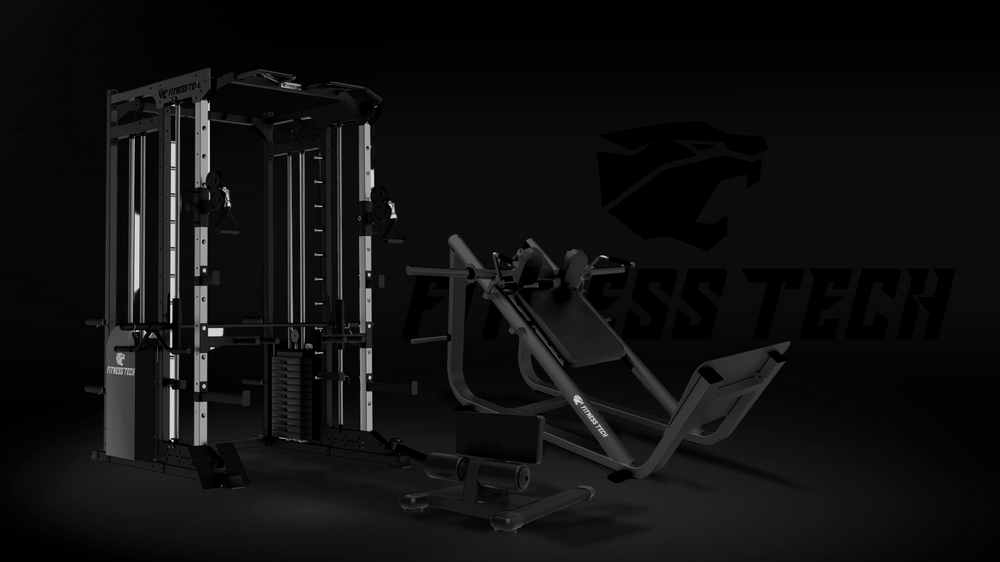


Compact, functional solutions adapted to any space
Creating a home gym is a practical way to train freely, without travel, and with equipment adapted to your goals. At Fitness Tech, you will find multifunction machines, Smith machines, benches, free weights, technical flooring, functional accessories, and cardio options to progressively configure your home gym.
Our range is designed for those who want to train strength, cardio, mobility, or physical conditioning from home, making better use of the available space. From a compact area in a room to a full garage, you can set up a comfortable, versatile home gym ready to evolve with you.
Why setting up your home gym is worth it
Setting up a home gym allows you to train with more flexibility, make better use of your time, and always have the equipment you need available. It is especially useful for those who train regularly and are looking for a comfortable alternative to a traditional gym membership.
Besides saving on travel, a home gym allows you to train privately, tailor each session to your level, and organize the space according to your routines. You can start with basic equipment and expand with machines, free weights, functional accessories, or cardio depending on your goals.
Real savings compared to the gym membership fee
The investment in home equipment can pay off over time, especially if you train several times a week. Instead of relying on a monthly fee, you can gradually build your own training area with equipment that is available every day.
The savings will depend on the type of equipment chosen, the number of people using it, and the frequency of training. A basic kit requires a low investment, while a complete area with a bench, barbell, plates, or a Smith Machine involves a higher investment but also offers more training possibilities.
Total flexibility: train whenever and however you want
One of the main advantages of having a home gym is the freedom of schedule. You can train before work, at the end of the day, or in short sessions, without depending on travel, opening hours, or machine availability.
It also allows you to adapt your training to your own pace, repeat exercises calmly, and maintain a more consistent routine. For many people, having the equipment at home makes it easier to stick to their training and helps turn exercise into a sustainable habit.
What you need to set up your home gym
The ideal equipment to set up a home gym depends on three main factors: training goal, available space, and budget. Someone starting with basic strength training doesn’t need the same as someone looking for a complete area for weight training, cardio, and functional training.
The most recommended approach is to start with a versatile base and expand progressively. A mat, adjustable dumbbells, resistance bands, and a bench can cover many initial routines. From there, you can add barbells, plates, kettlebells, multifunction machines, cardio, or technical flooring.
Basic equipment: the essentials to get started
To start training at home, it’s not necessary to fill a room with machines. A basic kit can include a mat, dumbbells, resistance bands, bench, and barbell, allowing you to work on strength, mobility, core, and functional exercises in very little space.
- Mat: useful for floor work, mobility, abs, and stretching.
- Dumbbells: allow progressive strength training with a wide variety of exercises.
- Resistance bands: suitable for warm-up, activation, mobility, and resistance work.
- Bench: expands training possibilities with dumbbells, barbell, or bodyweight.
- Barbell and plates: recommended for progressing in basic strength exercises.
Complete equipment: strength, cardio, and functional
A complete home gym combines different training zones: guided strength, free weights, cardio, floor work, and functional accessories. This setup allows for more varied routines and working on strength, endurance, mobility, and fitness conditioning without leaving home.
For a more advanced area, you can add a Smith Machine, a multifunction machine, indoor bikes, adjustable benches, adjustable dumbbells, kettlebells, suspension systems, bands, foam rollers, or functional training accessories. The key is to choose equipment compatible with your space and the type of training you will actually do.
Functional accessories: TRX, bands, foam roller, and more
Functional accessories are an efficient way to expand the possibilities of a home gym without taking up too much space. Items like suspension systems, resistance bands, foam rollers, bosu balls, fitballs, or kettlebells allow you to work on strength, stability, mobility, balance, and coordination.
This type of equipment is especially suitable for dynamic workouts, circuits, warm-ups, core sessions, or complementary work to weight training. Additionally, many accessories are easy to store, transport, and combine with benches, free weights, or machines.
How to choose according to your space and budget
Before buying equipment for a home gym, it is advisable to measure the available space carefully and define what type of training you want to do. Setting up a basic area in a room is not the same as preparing a full garage with machines, free weights, and cardio.
It is also important to plan your investment in phases. You can start with basic equipment, then add a bench or adjustable dumbbells, and later incorporate a multifunction machine, a Smith Machine, or cardio equipment. This way, you avoid unnecessary purchases and build a gym adapted to your actual use.
Available space: from 4 m² up to a full garage
With 4 m², you can set up a basic area for a mat, dumbbells, resistance bands, and small accessories. This is a suitable option for functional training, mobility, core, and basic strength with minimal equipment.
With about 10 m², you can include a bench, adjustable dumbbells, barbell, plates, and a small area of technical flooring. If you have 20 m² or more, such as a garage or dedicated room, you can plan a more complete setup with multifunction machines, Smith Machine, cardio area, and free weight storage.
In spaces like terraces or garages, it is also important to consider floor protection, ventilation, humidity, and material storage. A good layout improves comfort, safety, and equipment durability.
By budget: options from basic to premium equipment
The budget will depend on the level of equipment you want to install. A basic setup can start with functional accessories, a mat, bands, and dumbbells. This is a suitable option for those who want to get started or train in small spaces.
At a mid-level, you can add an adjustable bench, barbell, plates, adjustable dumbbells, or kettlebells to increase variety and load progression. More complete or premium setups include multifunction machines, Smith machines, professional cardio, technical flooring, and storage solutions.
As a general guideline, you can consider three levels: basic equipment starting from €200, intermediate setups between €500 and €1,500, and more complete projects above €1,500. These ranges may vary depending on products, promotions, and specific space needs.
Home Gym Equipment Categories
At Fitness Tech, you can set up your home gym by combining different product families according to your goals: guided strength, free weights, benches, accessories, cardio, and training flooring. This variety allows you to create anything from a basic area to a complete space for bodybuilding and physical conditioning.
The choice of each category should respond to the type of training you want to prioritize. To gain strength, free weights and machines are key. To improve endurance, you can incorporate cardio. To protect the space and train comfortably, technical flooring and functional accessories make the difference.
Guided and safe strength: Smith machines and multifunction
Smith machines, multipower, and multifunction machines are a very complete option for strength training at home with greater movement control. They allow you to work several muscle groups in a single structure, integrating pushing, pulling, pulleys, squats, presses, or guided work exercises.
This type of equipment is especially useful when looking for a compact and versatile solution to train muscle without filling the space with independent machines. It can also provide a greater sense of safety during solo workouts, always respecting proper technique and appropriate loads.
Bars, plates, and dumbbells for training with freedom
Free weights are one of the foundations of any home gym. Dumbbells, bars, plates, kettlebells, and loading accessories allow you to work on strength, coordination, and stability with a wide variety of exercises.
Adjustable dumbbells are a very efficient option for small spaces, as they allow different weights without needing a full set of fixed dumbbells. Bars and plates, on the other hand, are ideal for basic strength exercises and more advanced progressions.
Benches and accessories: versatility without taking up space
A training bench multiplies the possibilities of a home gym. It allows you to perform presses, rows, dumbbell exercises, core work, and strength routines with greater stability.
Folding, multi-position, or adjustable benches are especially useful when space is limited, as they allow you to adjust the working angle and store the equipment more easily. Combined with dumbbells, bars, or functional accessories, they offer a very complete base for training at home.
Cardio at home: bikes, steps, and more
Cardio at home can be done with different types of equipment depending on the space, joint impact, and desired intensity level. Indoor bikes, stationary bikes, treadmills, steps, ropes, or functional circuits help improve cardiovascular endurance without relying on a gym room.
For low-impact workouts, stationary or recumbent bikes can be a good option. For more dynamic and compact sessions, steps, jump ropes, or circuits with functional accessories allow you to work on cardio while taking up less space. The choice should be adapted to the user's fitness level, goals, and comfort.
Training floor: tatami and protective tiles
The floor is a fundamental part of any home gym. It helps protect the flooring, cushion impacts, reduce vibrations, and create a more comfortable and safe training area.
For mobility, floor, core, or gentle martial arts training, puzzle tatami mats can be a practical and easy-to-install solution. For free weights or machines areas, rubber tiles offer greater protection against loads, impacts, and equipment movement.
The amount of floor space needed will depend on the available area and type of equipment. A basic zone can be covered with a few square meters, while a full garage or dedicated room will require more planning to differentiate strength, cardio, and mobility areas.
Home training for people over 60
Home training can also be adapted for people over 60, always considering physical condition, previous experience, mobility, and usual activity level. Not everyone needs the same type of equipment or intensity, so the key is to choose comfortable, progressive, and suitable material for each profile.
For users seeking gentle or low-impact sessions, accessories such as elastic bands, light dumbbells, comfortable mats, foam rollers, or reclined stationary bikes may be suitable. Active people or those who train regularly can incorporate progressive loads and more demanding exercises, always prioritizing technique, movement control, and appropriate intensity.
Recommended equipment for older adults
The recommended equipment will depend on the goal and physical condition of each person. To improve mobility, functional strength, and balance, elastic bands, light dumbbells, thicker mats, foam rollers, or support accessories for controlled exercises can be used.
For users who prefer low-impact cardio, a vertical or reclined stationary bike can offer a comfortable way to train cardiovascular endurance. In any case, it is important to progressively adjust the intensity and choose equipment that allows training with stability and confidence.
Safe and effective exercises from age 60
From age 60 onwards, the most suitable exercises are those that adapt to each person's actual level. Joint mobility work, balance, functional strength, core, and low-impact endurance can help maintain an active and consistent routine at home.
Some common examples include exercises with elastic bands, assisted squats, arm work with light dumbbells, shoulder and hip mobility, low-intensity treadmill walking, or stationary biking. People with injuries, discomfort, or specific conditions should adapt their training with professional guidance.